
As the European Drinking Water Directive (DWD 2020/2184) deadline approaches, choosing the right lead-free brass is no longer just a metallurgical decision—it directly dictates your tooling costs, casting yields, and cycle times.
While both alloys pass European Positive List (EUPL) compliance, their behavior on the factory floor couldn't be more different:
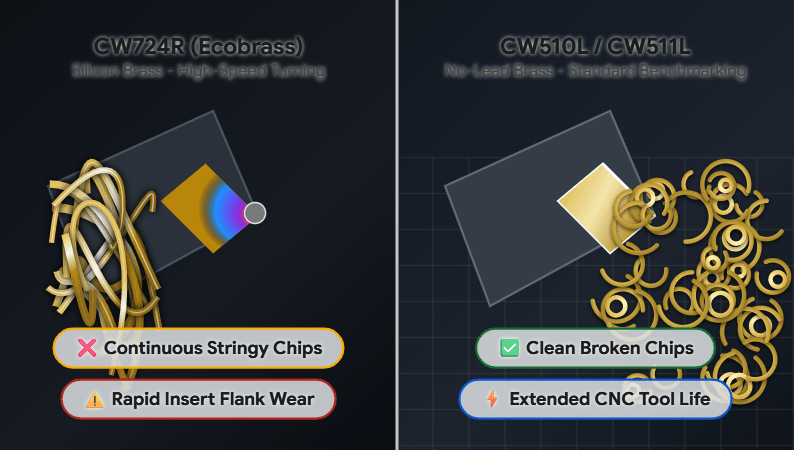
1. CW724R (Ecobrass / CuZn21Si3P) — The Heavy-Duty Casting Choice
- The Advantage: With ~3% silicon, CW724R offers exceptional fluid flow during gravity and low-pressure casting. It yields superior tensile strength (comparable to stainless steel) and outstanding dezincification resistance (DZR).
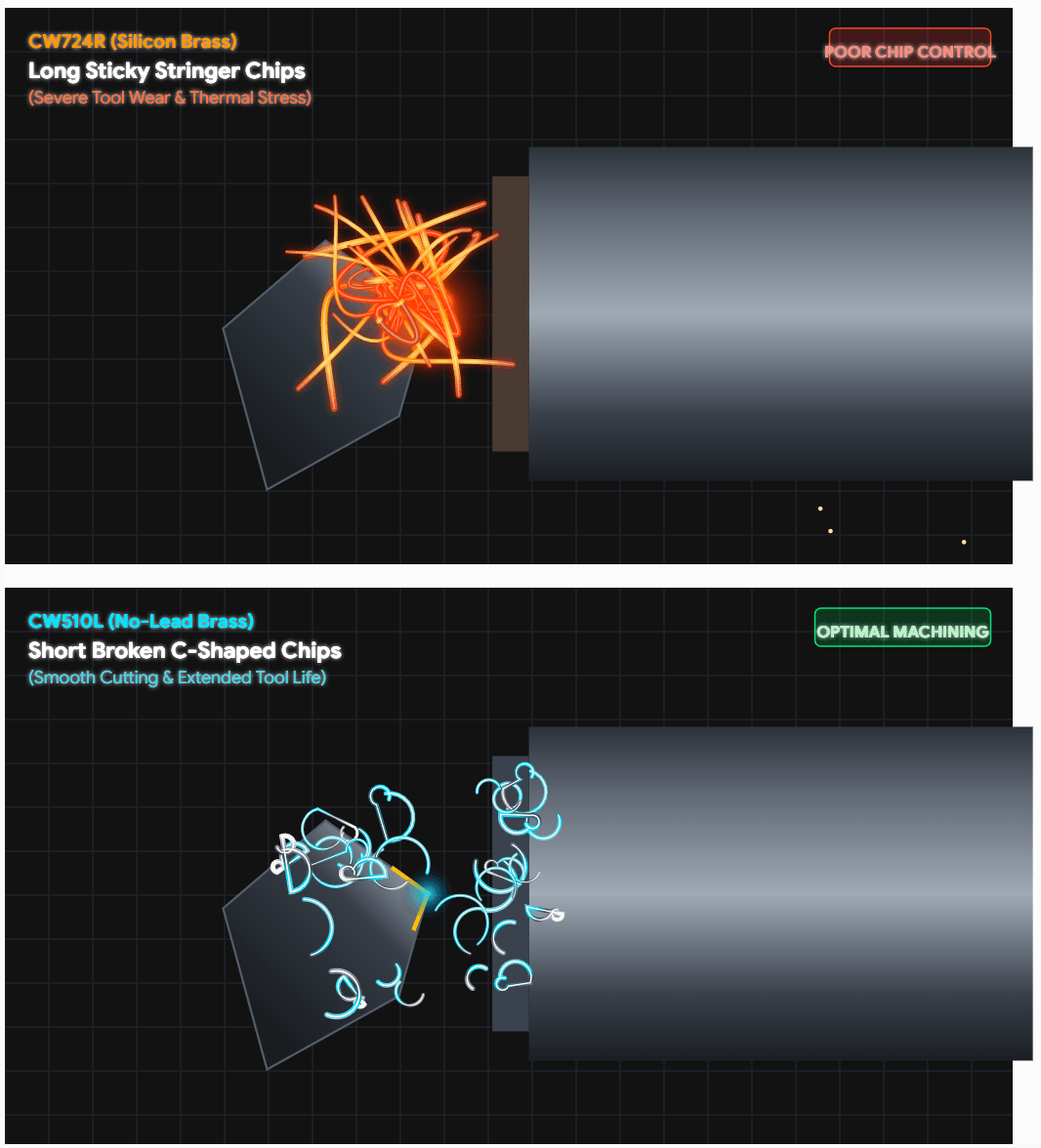
- The Manufacturing Reality: It is a notoriously aggressive "tool killer." High toughness leads to continuous stringy chips and rapid flank wear on CNC inserts. If your design requires heavy milling, expect tool costs to soar and machining cycle times to slow down by up to 30%.
2. CW510L / CW511L (CuZn42) — The Machining-Friendly Workhorse
- The Advantage: Significantly better machinability compared to silicon brass. It cuts smoother, preserves CNC tool life, and comes with a lower raw material surcharge (~10–20% more economical than CW724R).
- The Manufacturing Reality: Lower fluidity during casting. Complex internal geometries are prone to shrinkage, cold shuts, and surface porosity, leading to elevated casting scrap rates if mold temperatures aren't meticulously controlled.
The Engineering Trade-Off:
👉 Choose CW724R if your component requires complex integral casting or extreme mechanical strength, and you can absorb higher CNC processing costs.
👉 Choose CW510L/CW511L if your part relies heavily on precision CNC turning/milling from extruded rods, where cycle time and insert wear dominate your BOM.
Is There a Third Path?
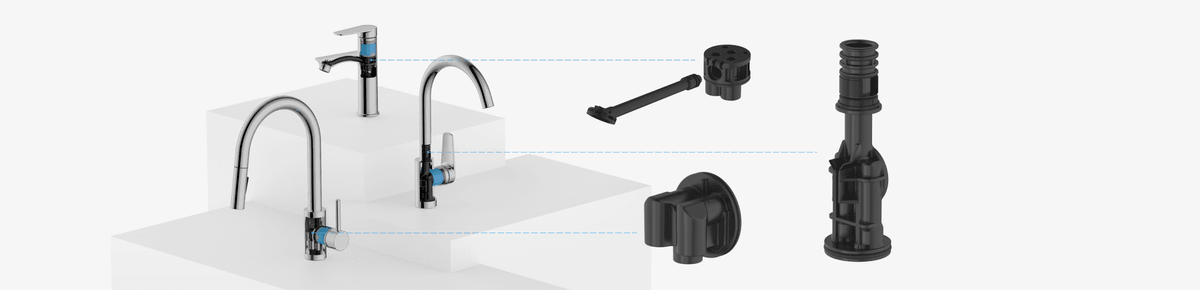
For intricate, non-cylindrical, or electronic kitchen faucets, forcing all internal passages through solid lead-free brass casting often creates an unnecessary margin bottleneck.
Many forward-thinking OEMs are separating the structural shell from the water path—utilizing die-cast outer housings paired with independent engineered polymer inner waterways (PPA). You achieve 100% zero-lead compliance, eliminate machining wear entirely, and maintain complete aesthetic freedom.
💬 Question for R&D Managers & Sourcing Directors:
When transitioning your brass lines, where are you seeing the biggest friction:
CNC tool wear or casting scrap rates?