In the European sanitaryware market, "Brass" and "304 Stainless Steel" have long been treated as the gold standards for faucet manufacturing. Conversely, Zinc Alloy often carries a historical stigma—frequently associated with cheap construction, corrosion risks, and premature mechanical failure.
However, as European drinking water standards become stricter (such as the EU Drinking Water Directive 2020/2184 and Germany’s KTW-BWGL certification), traditional metal faucets face unprecedented challenges regarding lead leaching and metal ion migration.
It is time to look beyond legacy assumptions and examine how modern materials science is revolutionizing faucet architecture.
Myth 1: "Zinc Alloy Faucets Contaminate Drinking Water"
Reality: Not when water-contact components are completely isolated by certified PPA engineering polymer.
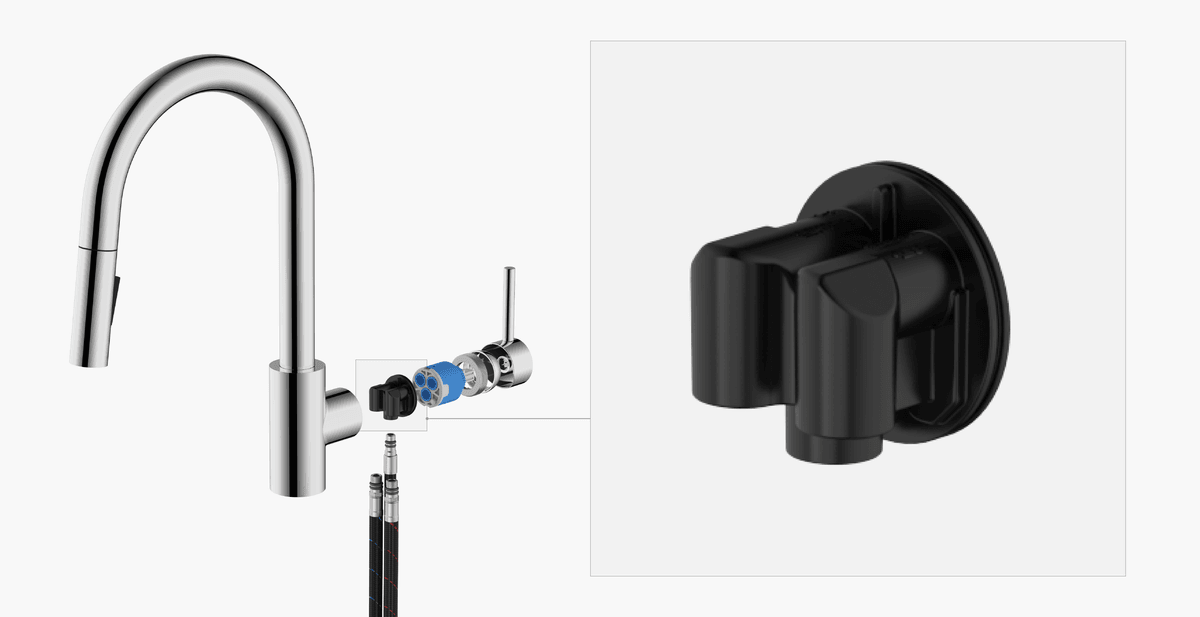
The primary concern with low-quality zinc faucets is direct water contact, leading to zinc oxide formation and metal leaching. In high-performance composite designs, Zinc Alloy NEVER touches drinking water.
By leveraging high-temperature Polyphthalamide (PPA with >50% Glass Fiber reinforcement) supplied by world-leading chemical suppliers like BASF and EMS-CHEMIE, the entire internal waterway is fully enclosed:
- Zero Heavy Metals: PPA is 100% lead-free, nickel-free, and corrosion-proof.
- Global Compliance: Certified for strict European drinking water standards (KTW-BWGL, ACS, WRAS, NSF61).
- Thermal & Chemical Inertness: Unlike metals, PPA does not scale, pit, or degrade in hard or chlorinated water environments.
Myth 2: "Zinc Alloy Lacks Structural Strength and Explodes Under Pressure"
Reality: Structural performance depends on engineering design. PPA GF50 & GF60 provides high burst pressure resistance.
A common fear among European buyers is water hammer damage or thread cracking under high system pressure.
1. High Structural Rigidity: PPA reinforced with >50% glass fiber possesses mechanical tensile strength comparable to cast brass, handling high burst pressures (exceeding 35-50 bar testing standards).
2. Thermal Stability: Engineered for extreme hot water conditions (continuous operation up to 90°C and peak temperatures up to 120°C) without deformation or degradation.
3. Optimized Zinc Alloy Casting: The outer zinc shell serves exclusively as a durable, beautifully electroplated structural casing—free from internal hydraulic pressure stress.
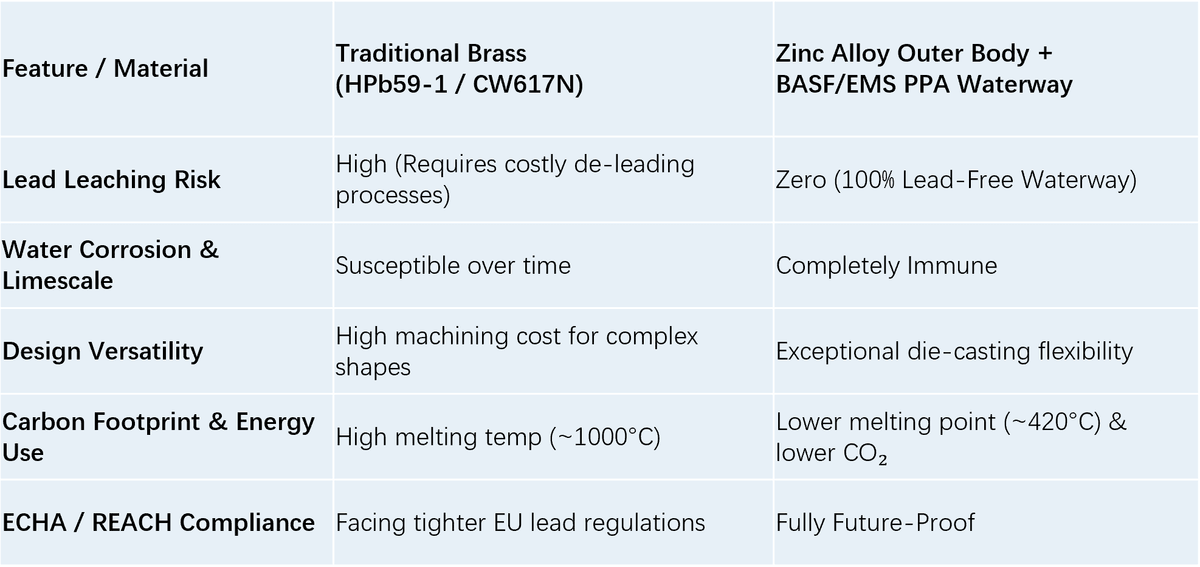
Myth 3: "Traditional Brass is Always Superior to Composite Solutions"
Reality: Brass carries inherent lead risks and higher carbon footprint.
The Verdict: Precision Engineering for Next-Generation Faucets
The debate shouldn't be about "Zinc vs. Brass", but rather "Unprotected Metal vs. Smart Material Isolation".
By combining die-cast Zinc Alloy for external elegance with BASF/EMS PPA GF>50% for pristine internal water purity, modern OEM manufacturers are delivering a faucet solution that is safer, greener, more durable, and fully compliant with future European directives.